Filtered out by the bots — and flattened into the average by the AI that's meant to help.
You're stuck between invisible and identical. Recruiters find you by exact-term search and judge you in a fast skim. Miss the term once, you're never found. Read as generic, you're read as junior. And the generic AI that's meant to help rewrites you toward the average, stripping the very seniority signal that makes you you.
Read as junior
The senior signals get smoothed out: scope, authority, outcomes. A recruiter reads "solid mid-level," not the leader you are.
Invisible to the search
Recruiter search needs the exact term. One missing phrase and you're never found, no matter how well you fit.
Sounds like a bot
Keyword-stuffed CVs read as fake. Recruiters increasingly bin the AI "tell."
Hours per application
Tailoring every CV by hand doesn't scale to a high-volume search.
Twenty applications, no reply. That is information about the market, not a verdict on you.
There are two ways to be unread. One is to be misread: your seniority flattened, your terms missing, your CV binned in the skim. The other is quieter. You are read correctly, by the wrong door. No amount of polishing fixes the second one, and you cannot see it from a job board: you see the roles you searched for, not the ones you never thought to search.
The same door, harder
Applying again into one role family, with a better CV each time, tests the CV. It never tests the aim.
A search the width of your job title
Keyword search only returns what you already know to ask for. The roles your experience would carry are the ones you never type in.
Effort as the only lever
When the only thing you can change is how hard you try, silence reads as a verdict on you. It usually is not.
Your profile, scored against every role family we track.
Not a job search. A read of where your experience already carries weight, and how much is live in each direction right now. Strong, Moderate and Stretch are shown the same way, because a Stretch you can see is worth more than a certainty you cannot.
Where your profile points
Illustration. Your own bands and counts are computed from your history against the live corpus.
Directions, not job alerts
Each family carries what is live in it now, so a direction with real movement is distinguishable from one with none. That is the answer to "should I keep going here, or look one door over".
Why you fit, requirement by requirement
Open a family and it scores its actual requirements against your history: which ones your experience already answers, and which it does not. The case for a move, in the market's own words rather than yours.
Three questions the product keeps answering after you close the tab.
A search that only runs while you are looking at it is another thing to keep up with. These run on the corpus whether or not you are there.
Should I apply to this now?
Timing on the roles you are already matched to, so an hour of tailoring goes to the one that is worth it today.
What changed on what I saved?
Roles close quietly. You find out when you go back. This tells you when something you saved has moved.
What are my target companies doing?
Activity at the employers you track, so a company opening up is a signal you get rather than one you miss.
Everyone else optimizes for more. We optimize for you.
Most tools answer the filter with more volume: "match your résumé to any role," reverse-engineered keywords, apply faster. That volume is now the problem.
What most tools sell
- "Match your résumé to any role"
- Reverse-engineer the job's keywords
- Apply to everything, faster
- More applications → more sameness → silence
What actually gets read now
- Semantic match, not keyword match – Advanced algorithmic scoring reads what your experience means against a role, the way a human recruiter does – never a keyword tally. So you're never pushed to stuff terms that game a filter and hollow out the meaning behind the work
- Grounded – Works only from your real experience, never invented or inflated a word
- Governed – Hard quality gates refuse anything junior, generic, or keyword-stuffed
- No AI tell – Written like a person, not the LLM voice recruiters filter out – you approve every word
- ATS-legible – Clean structure and the right vocabulary; the parser reads you correctly first time
Evidence, not keywords. Every line on your CV traceable to something you actually did.
Send fewer. Get further.
The robot isn't rejecting you. The truth is harder.
The ATS auto-reject myth is wrong. Human decisions do the filtering. Keyword-stuffing and AI sameness are exactly the wrong answer.
Sources: recruiter survey, 2025 (92%) · iCIMS 2026 Workforce Report (67%) · HR.com recruiter survey (76%)
And the corpus those directions are read from: .
"Hiring is stuck in an AI doom loop."— Daniel Chait, CEO, Greenhouse
One reviewed profile powers everything — CV, cover letter, LinkedIn, interview prep — all speaking at the same senior level.
The CV is the centrepiece. Evident automates the workflow around it, so the judgment, the documents, and the tracking live in one place.
Scored fit & gap report
Paste a job link – get Profile, Career and ATS scores, a verdict, and a capability-by-capability read of where you fit and where to sharpen. Before you spend an hour.
The full application kit
Cover letter, LinkedIn rewrite, and gap-aware interview prep: every piece grounded in the same reviewed profile as your CV, per role.
One pipeline, no spreadsheet
Every role, score, CV and document tracked in one board: from saved to applied to interview.
Your story, entered once
Import your CV, review what we found. One source of truth powers every document, and refining it moves your scores in real time.
Discovery mode. The search that runs without you.
Track employers from the set Evident crawls, and each new role they post is scored against your career target as it lands. Good fits arrive already scored, still reading at your level. You keep or dismiss. The roles come to you. Companies never see your watchlist.
Three steps to a tailored CV. About fifteen minutes to set up, then minutes a role.
-
Tell it your story once.
Import your CV. Evident reads it and builds your profile: roles, dates, skills, education. You just review what it found. That fact base powers every document.
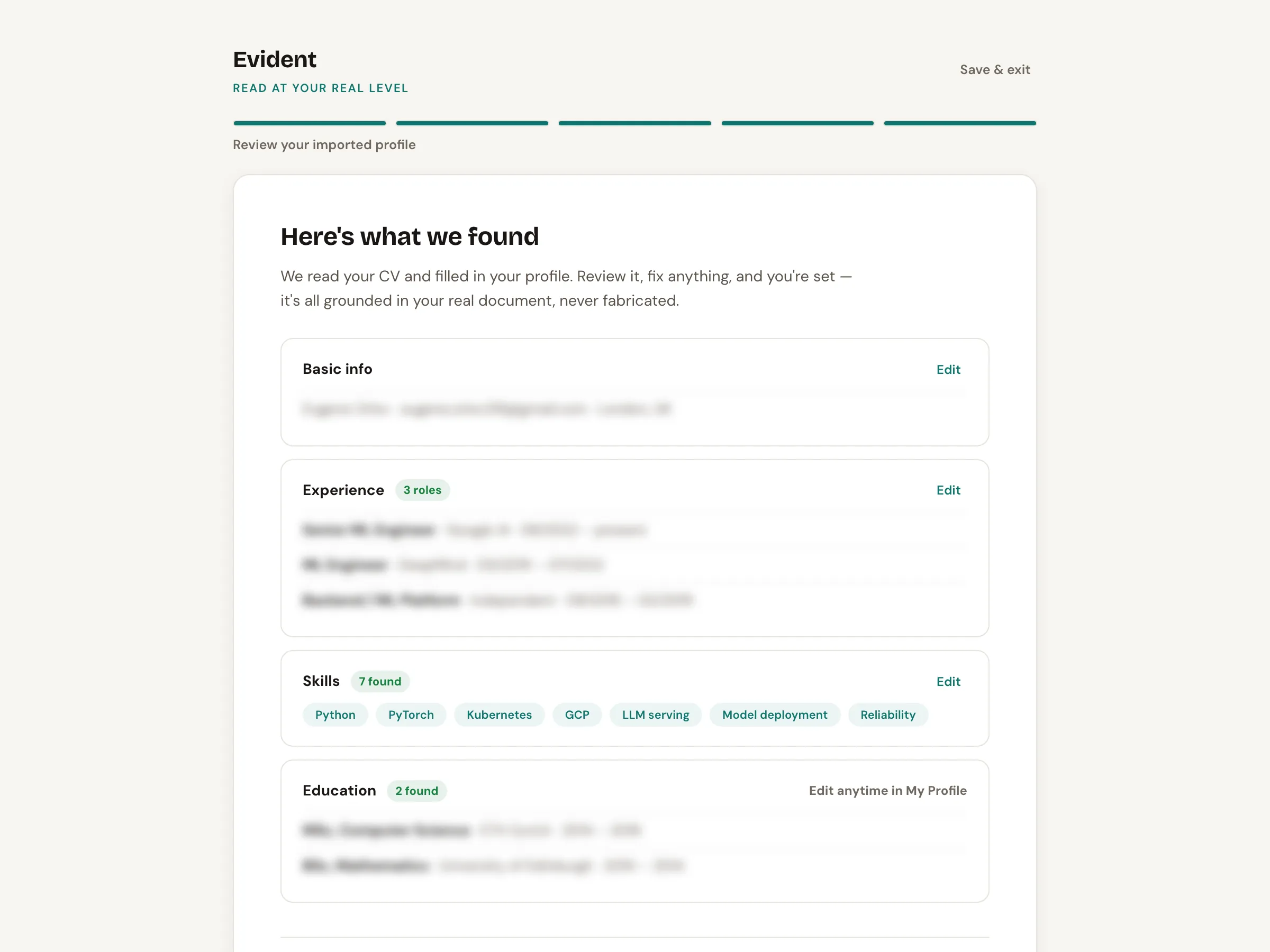
Your full career, extracted once. Review and confirm. No re-typing. -
Drop in a job.
Paste a job link or description; the engine scores your fit and gives a verdict before you invest an hour: worth tailoring, or not worth your evening. Or skip the pasting: track employers Evident crawls, and discovered roles arrive already scored.
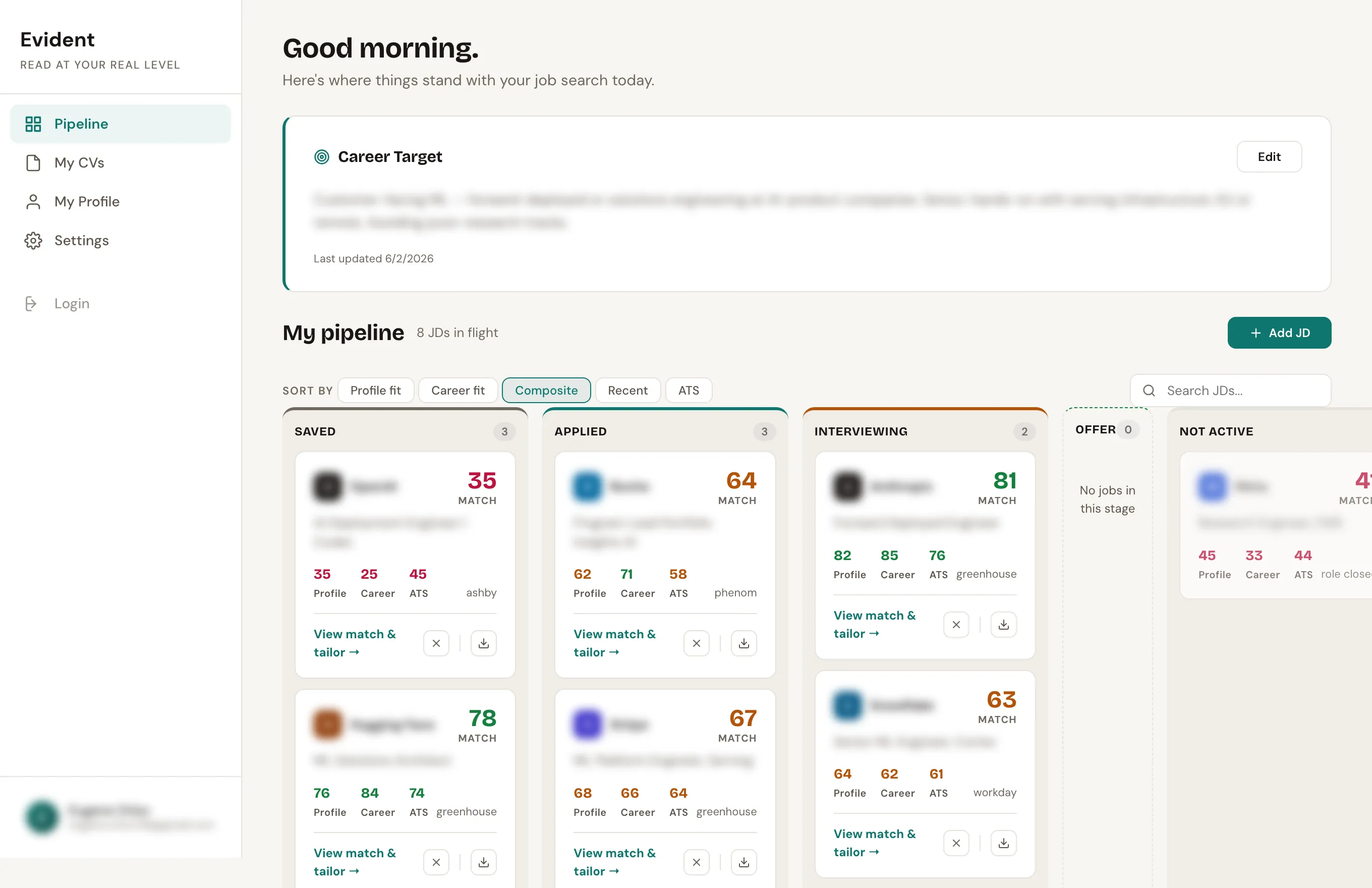
Drop in a job link. Three scores before you commit: Profile, Career and ATS fit in one read — the 64 you'll watch climb. -
A CV that gets read.
An ATS-legible CV that reads at your real level, written like a person. The engine reads the role's story and proposes the sharpening moves – or steer the positioning yourself. Every change lands in the live preview.
It proposes the moves; you steer. Every change lands in the live preview – yours to approve — the same role from step two: 64 → 71.
Small cohorts, by invitation.
- Leave your email. Invites go out in small cohorts; once you’re in, it’s about fifteen minutes to your first scored role.
- Invitation only, in small cohorts — not an open sign-up
Nothing is ever sent, posted, or visible to anyone. Evident drafts; you download and apply yourself. The LinkedIn rewrite is copy for you to paste. We never make that change for you.
Get early access
Enter your email. We're onboarding a small private beta by invitation — if you're a fit, you'll get a personal invite. Everyone else stays on the list and hears from us first when we open more places. Pricing, when it arrives, is shown in full before anything is ever charged.
Evident will be a paid professional tool at launch. Early-access members hear pricing first.
One email when it's your turn. No spam, no sharing. Your data lives in the EU (Ireland). Privacy policy.
Straight answers.
Everything Evident produces for one role, start to finish. No email needed.
Why not just paste my CV into ChatGPT?
ChatGPT gives you a single, ungoverned shot: no fit scoring, no quality gates, no check that the output reads senior rather than average. Evident runs a quality-checked pipeline: it scores your fit against a specific role before you invest an hour, routes the rewrite through hard quality gates that refuse to ship anything generic or keyword-stuffed, and builds every document from one reviewed profile that you approve. The full kit comes too: cover letter, LinkedIn rewrite and interview prep, per role.
One reviewed profile that builds everything beats a series of single-shot prompts.
What happens to my CV and data?
Your CV and career history are stored only to run your search – never sold, never shared, deleted on request. See our privacy policy for the full details.
Is this cheating? Will it lie on my CV?
No, by design. It only works from experience you actually have. It makes that experience legible to the ATS and the recruiter; it never invents it.
What does it cost?
Evident will be a paid professional tool. The private beta is invitation-only, and pricing is shown to you in full before anything is ever charged. No surprises, no quiet charges.
I'm senior. Won't AI make me sound generic and junior, like every other tool?
That's the precise problem Evident exists to solve. Generic AI optimizes for the average. You are not. Evident turns your duties into proof (what you did, how, and what changed, with a number from your own history) so recruiters read the strategic, senior, specific you – not a flattened sameness.
Won't an AI-written CV just get flagged and rejected?
Evident is built against this exact failure. Recruiters bin CVs that read as machine-written – three in four say they prefer natural language to decontextualised keyword blocks, and a CV flagged for manipulation is 67% less likely to advance even when the person is qualified. Both numbers are sourced in the evidence section above. A governed pipeline with hard gates refuses to ship anything that reads junior, generic, or keyword-stuffed; it's written to sound like a person in a natural, senior register – not the LLM voice recruiters filter out. One gate in action: if a rewrite introduces a claim that isn't in your history, the pipeline rejects it and tries again.
Will it write in my personal voice?
Not yet, and we won't pretend otherwise. Today Evident writes in a clean, human, senior register, grounded in your experience, and you review, refine, and approve every word, so the final pass is genuinely yours. True voice calibration (learning your register from your own writing and drafting in it) is coming in a future version.
Will this get me the job?
No tool can promise that; anyone who does is selling you something. A clear, legible CV gets you past the filter and in front of a human reader. That gets you in the room. Much of the senior market is filled before a role is even posted. Evident's job is to make sure your CV is never the reason you were screened out. When you're read, you're read correctly.
How is this different from Jobscan, Teal, or Rezi?
They're built on one promise: "match your résumé to any role" by reverse-engineering its keywords. That worked until everyone did it. Now recruiters spot the keyword-perfect, AI-written sameness and bin it, and candidates are stuck sending hundreds of applications into silence. Evident does the opposite: it matches you only to the roles worth your time, building on your experience and career goals, so you apply to fewer and actually get read. Send fewer. Get further.
Is this just a CV builder?
No. Building the CV is one half of the product and career intelligence is the other: your profile scored against every role family we track, with what is live in each, before you decide where to spend the effort. Around both, Evident runs the workflow: a scored fit-and-gap report for every job you add, a per-role kit (cover letter, LinkedIn rewrite, interview prep), and one pipeline board tracking every application. You enter your story once; everything builds from that single reviewed profile.
Can you tell me which fields are growing?
No, and we would rather say so than publish a number we cannot stand behind. We show what is live in the corpus right now, across every role family, and how your profile scores against each of them. Whether a field is rising or falling is a different claim, measured over time, and we do not make it yet. What you get instead is current and checkable: where the roles actually are today, and which of them your experience already fits.
I'm changing careers. Does this work for me?
It is the case the intelligence is built for. Your profile is scored against every role family we track, not against the title on your last contract, so families you would never have searched for come back with a band and a live count. Open one and you see its real requirements checked against your history: what you already answer, and what you do not. A Stretch is shown at the same weight as a Strong, because knowing a direction is a stretch is the useful part.
Who is it for?
The people who feel the filter most acutely: senior operators in transition and mid-career professionals (roughly 5–15 years in and up) applying through ATS portals at volume: anyone whose senior experience gets flattened into generic keywords. Career-switchers and people returning to work benefit too. We're starting where we serve best and expanding from there.
Do I need to be technical?
No. If you can paste a job description, you can use it.
Ready to be read at your level — and aimed where the roles are?
Private beta, invitation only. Send fewer. Get further.
Get early access →